UNCP Awards First Doctoral Degrees, Marking a New Chapter in University History
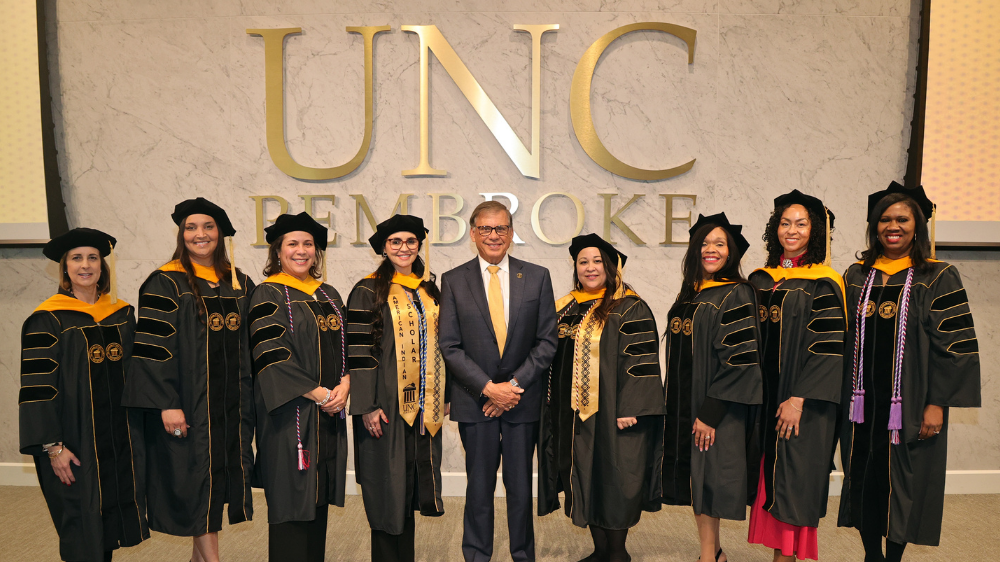
As the lights rise inside Givens Performing Arts Center tonight, eight nurse leaders will step onto the stage and into the history books. Their doctoral hoods, symbols of perseverance, scholarship and service, mark a moment 138 years in the making for the University of North Carolina Pembroke.
For graduates like Jennifer Bigger of Fayetteville, who will be the first to cross the stage, the milestone carries profound personal meaning. After more than 30 years in healthcare, Bigger sought a terminal degree aligned with her lifelong work in population health and quality improvement.
“Being among the first DNP graduates in UNCP’s history is something I’ll carry for the rest of my life,” said Bigger, vice president of Quality Improvement & Health Informatics at Southern Regional AHEC. “This program had the right focus, the right flexibility and the high standards I knew I could trust.”
She is joined by nurse leaders from communities across North Carolina who were drawn to UNCP’s specialized focus on population health. Vilma Ferrell of Greensboro, an assistant professor at North Carolina A&T State University, said she waited years for the right doctoral program. She refreshed the UNCP website for months, waiting for the first DNP information session to open.
“This degree speaks directly to the work I do every day,” Ferrell said. “I knew it was the next step if I wanted to improve outcomes for the communities I serve.”
Their stories reflect the statewide reach of UNCP’s Doctor of Nursing Practice (DNP) in Population Health — launched in 2023 as the university’s first doctoral program and one of the few in the state dedicated to community-level health outcomes. DNP-prepared nurses evaluate systems of care, identify barriers and facilitators and design evidence-based solutions to improve outcomes across rural, tribal and underserved communities.
The eight graduates will receive their doctoral hoods during Friday evening’s Graduate School Ceremony at Givens Performing Arts Center. The ceremony begins at 7 p.m. and will be live-streamed for families, colleagues and community members.
This achievement marks both an academic milestone for the institution and a new chapter in healthcare in southeastern North Carolina. The first cohort represents working parents, first-generation doctoral graduates, public health advocates and clinicians whose projects are already reshaping care in real-time.
“The graduation of our inaugural DNP class is a major academic achievement for our university and a turning point for healthcare in our region.” said UNCP Chancellor, Robin Gary Cummings. “These graduates represent the next generation of nurse leaders who will address critical gaps in care, elevate clinical practice and expand access for rural and underserved populations.”
“This is a transformative moment for the School of Nursing,” said Dr. Jennifer Jones Locklear, chair of the McKenzie Elliott School of Nursing. “Our graduates will carry forward equity-focused strategies that strengthen care in rural and underserved communities and position UNCP to influence policy, practice and systems-level change.”
From the start, the program required students to bring research off the page and into the community.
“UNCP’s DNP is about making change where people live and receive care,” said Dr. Deborah Hummer, director of graduate programs for the McKenzie Elliott School of Nursing. “Our students learn to implement research in underserved settings and design solutions that address real problems in the communities we serve.”
UNCP’s investment in population health extends far beyond the DNP program. A study by UNC-Chapel Hill’s Sheps Center shows that the university’s service region has fewer health professionals per capita than the state average, underscoring the urgent need for additional health professionals. In response, UNCP launched a major health sciences expansion in 2018, establishing the College of Health Sciences and adding programs aligned with the region’s greatest needs — including the DNP, the Master of Healthcare Administration (MHA), the Master of Social Work advanced standing option, the Master of Science in Occupational Therapy (MSOT) and other advanced degrees designed to strengthen clinical and community care in rural southeastern North Carolina.
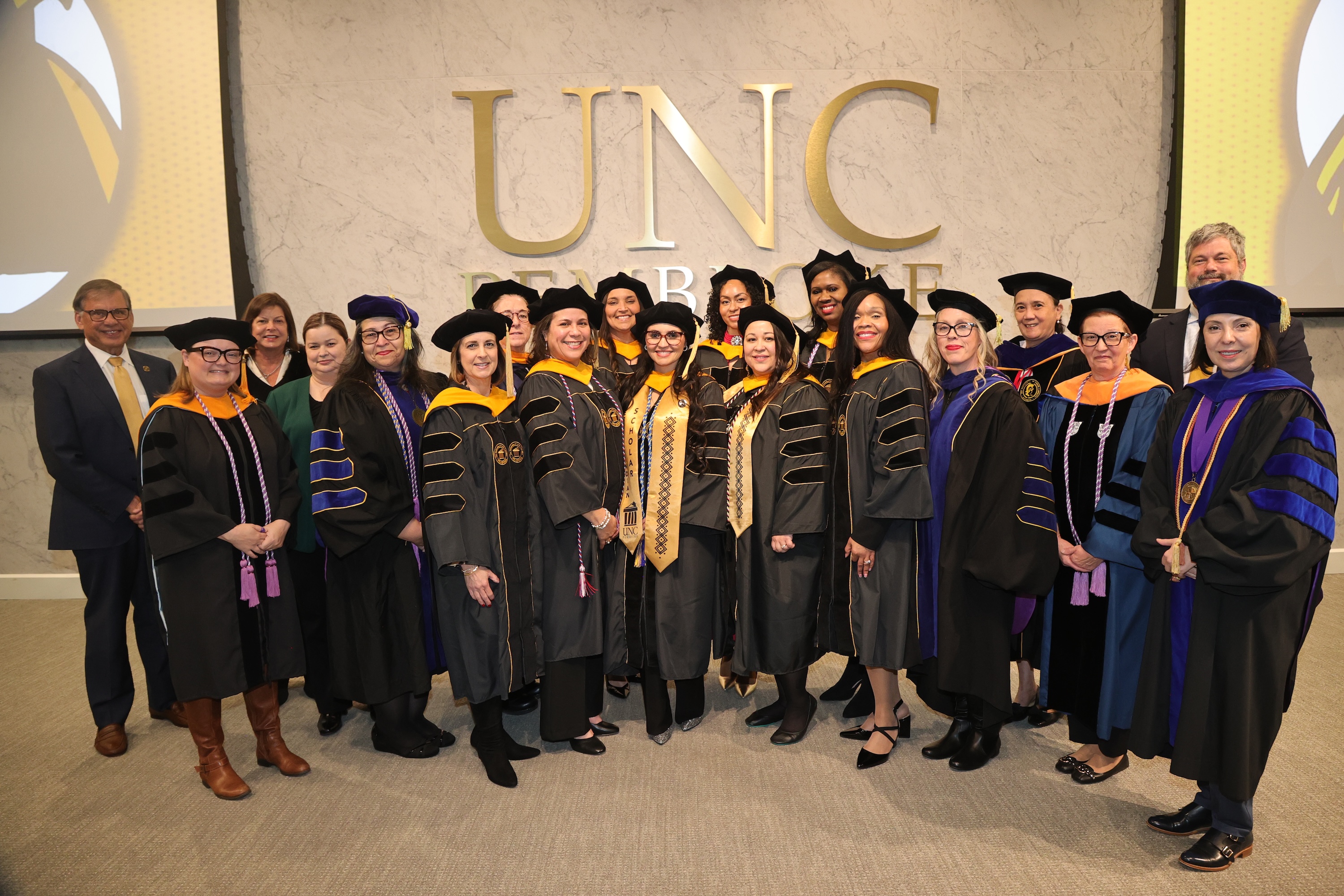
A cohort of statewide nurse leaders will join Bigger and Ferrell in their regalia, Friday, each bringing a distinct path and a powerful sense of purpose to the program.
Together, the eight graduates’ stories demonstrate how the DNP in Population Health attracts nurses committed to improving care where it’s needed most.
A chance conversation at a cancer summit inspired Shelli Spence of Monroe to pursue her doctorate, making her the first in her family to do so. She said UNCP’s program fundamentally reshaped her understanding of equity and belonging in healthcare.
“The transition from master’s-level to doctoral-level work was intense,” Spence said. “But UNCP’s support systems, and the program’s grounding in tribal history and population health, reshaped how I view equitable care. As a Black woman, I didn’t always receive the care I deserved. I want patients to feel seen and safe.”
At Shaw University in Durham, Angela Coleman-Talbot, director of Student Health and Wellness, applied the population-health strategies she learned in the program to strengthen mental health support for students. Her capstone introduced a two-question depression screening in the primary care center. That process is still in use today.
“When it comes to practice and population health, this program helps you understand the severity of the needs and the fact that you can make a difference,” she said.
Nurse practitioner Taren Hunt of Pembroke, who cares for patients with chronic conditions at UNC Health Southeastern in Lumberton, said the DNP strengthened her ability to advocate for evidence-based change. Hunt began volunteering in nursing homes at age 12 and later followed her mother — an ICU nurse and UNCP alumna — into the profession, carrying forward a passion for community health that shaped her doctoral focus.
“You’re seeing recommendations for higher-qualified nurses in clinical settings,” Hunt said. “I wanted to meet or exceed that standard and give my patients the best level of care.”
For Jessica Locklear, also of Pembroke, who earned her BSN, MSN and now DNP at UNCP, the degree reflects years of both personal and professional growth.
“Professionally, I’ve grown so much — from learning the basics of nursing to growing as a leader and now, in the doctoral program, learning about population health and rural health and how we can improve communities,” Locklear said.
In Cary, Ursula White, owner of Oaks Health MedSpa and an advanced practice provider, balanced the demands of her business with more than 1,000 clinical hours and a rigorous doctoral project while completing the program. She said the DNP challenged her in new ways but also surrounded her with faculty who created a family-like atmosphere and offered personalized guidance every step of the way.
White’s capstone focused on standardizing clinical guidelines in medical aesthetics to improve patient safety and consistency, an emerging field where evidence-based protocols are often lacking. She plans to publish her work and advocate for statewide and national practice standards.
“This program pushed me, supported me and gave me the tools to lead with confidence,” White said. “To graduate as part of UNCP’s first doctoral class is an honor. As a veteran and the first in my family to earn a doctorate, I’m proud to help shape a future where clinical practice is safer, more consistent and grounded in evidence.”
White’s goals reflect the broad impact of the DNP, a degree designed to prepare nurse leaders for emerging challenges across every corner of the healthcare landscape.
That reach is evident again in the work of Lisa Dial-Hunt, who works for Scotland Healthcare System in Laurinburg. In her capstone, Dial-Hunt partnered with food pantries and soup kitchens to measure how healthier food distributions affect patient outcomes.
She describes the DNP journey as “…a mountain. Long, steep and worth it.”
And as she stands at the summit with her fellow classmates, Dial-Hunt, who is celebrating her birthday is clear about what comes next.
“I am leaving ready to lead in my community,” she said. “Now the real work begins.”
 Play Video